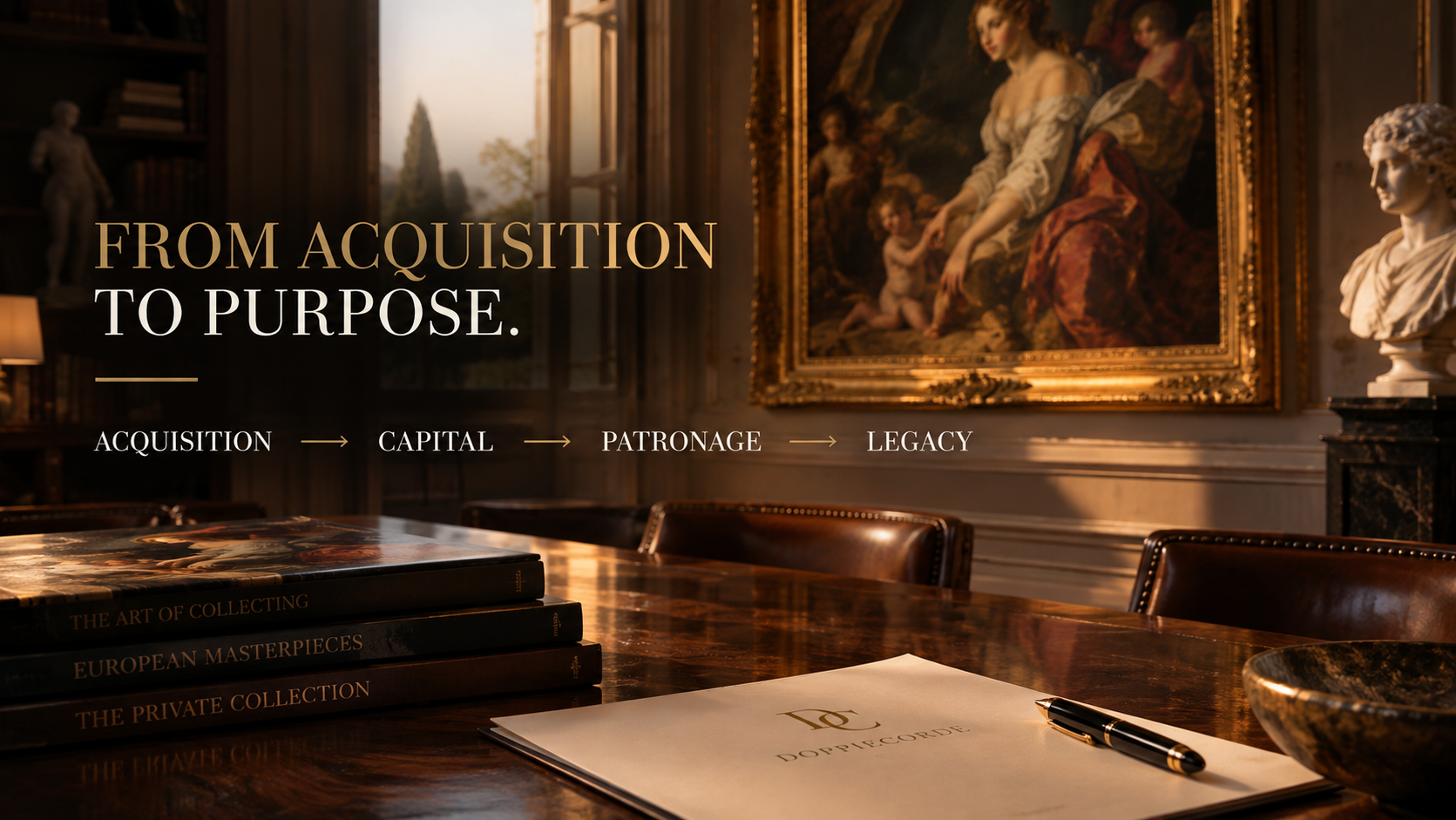
Art advisory is a highly personal and strategic service that helps private collectors, families and institutions make informed decisions about acquiring, managing and developing meaningful collections.
Collecting art is rarely only about acquiring an object. A significant collection develops through knowledge, relationships, judgment and time.
A private art advisor works alongside the collector, bringing together cultural understanding, market knowledge and access to a network of galleries, dealers, auction houses, specialists, institutions and private collections.
At Doppiecorde, art advisory is approached as a long-term relationship: understanding the collector first, and the individual acquisition second.
What Does an Art Advisor Do?
An art advisor represents the interests of the collector throughout the process of building, refining and managing a collection.
Depending on the needs of the client, this may include identifying potential acquisitions, researching artists and works, assessing provenance and condition, providing market context, coordinating independent specialists, assisting with negotiations and supporting the long-term management of the collection.
The role is not simply to locate objects. It is to help the collector understand why an acquisition belongs within a collection and how it relates to the collector’s broader cultural and personal objectives.
Art Advisor vs. Art Consultant
The terms art advisor and art consultant are sometimes used interchangeably, but the relationship can be different.
Art consulting may focus on a particular project, acquisition or decorative objective. Private art advisory generally involves a broader and more enduring relationship with the collector, encompassing strategy, acquisitions, research, collection development and stewardship over time.
For established and emerging collectors alike, continuity can be particularly valuable. Understanding the history of a collection makes it possible to evaluate future opportunities within a larger context.
How Does an Art Advisor Help With Acquisitions?
An advisor may identify opportunities through galleries, dealers, auction houses, artists, private collections and professional relationships developed over many years.
Before an acquisition is considered, the work itself should be evaluated within its appropriate context. Depending on the object, this can include authorship, provenance, condition, documentation, exhibition history, literature, comparable works and relevant market information.
For important acquisitions, independent expertise may also be required. Conservators, scholars, legal professionals, insurers and other specialists can form part of the due-diligence process.
Provenance, Condition and Due Diligence
Due diligence is an essential part of responsible collecting.
Provenance can help establish the history of ownership of a work, while condition reports provide information about its physical state, restoration history and conservation requirements. Authenticity, attribution, title and supporting documentation may require additional specialist review.
No single document should automatically replace careful evaluation. The appropriate level of diligence depends on the work, its history, its value and the circumstances of the transaction.
Conservation and condition assessment are also central to responsible collection stewardship. The Getty Conservation Institute provides extensive research and professional resources on preventive conservation and collections care.
Building a Collection With a Long-Term Perspective
A meaningful collection is usually built over time.
Rather than approaching acquisitions as isolated transactions, an advisor can help a collector establish a coherent direction while remaining open to discovery. Quality, rarity, cultural significance, personal relevance and market context can all play a role.
Long-term collection strategy may also consider documentation, conservation, insurance, storage, loans, exhibitions, succession, philanthropy and, when appropriate, deaccessioning.
The objective is not simply to accumulate objects, but to create a collection with identity, continuity and purpose.
Can an Art Advisor Help Build the Long-Term Value of a Collection?
An advisor can help a collector make more informed decisions by considering quality, provenance, rarity, historical significance, condition and market context. These factors may contribute to the long-term strength of a collection.
Art, however, should not be presented as offering guaranteed financial returns. Markets change, scholarship evolves and individual works can perform differently over time. A responsible advisory relationship distinguishes cultural and collecting objectives from promises of investment performance.
How Do Private Art Advisors Charge?
Art advisory compensation can be structured in different ways depending on the nature of the assignment and the relationship with the collector.
Arrangements may include advisory retainers, project-based fees, transaction-based compensation or another structure agreed in advance. What matters most is that the relationship and compensation structure are clearly understood by the client.
Transparency is particularly important where other parties involved in a transaction may also receive compensation.
How to Choose a Trusted Art Advisor
Choosing an art advisor is ultimately about trust, judgment and alignment. A collector should understand the advisor’s experience, areas of knowledge, professional network, approach to research and due diligence, and the way compensation is structured.
Equally important is independence of thought. A good advisor should be prepared to recommend patience when an opportunity is not right, rather than treating every available work as something that must be acquired.
The strongest advisory relationships often develop over years and extend beyond individual transactions.
Art Advisory for Private, Family and Institutional Collections
Advisory needs differ considerably from one collection to another. A new collector may require education, access and assistance defining an initial direction. An established family collection may need research, documentation, conservation planning or succession strategy. Institutions may require specialist sourcing, collection development or assistance with particular opportunities.
The advisory process should therefore begin with the collection and its objectives, rather than with inventory available for sale.
Private Art Advisory in Palm Beach and Beyond
Palm Beach is home to an international community of collectors, families, cultural institutions and patrons whose interests extend far beyond a single geographic market.
From Palm Beach, private advisory can naturally operate across borders, connecting collectors with opportunities and expertise in the United States, Europe and international art markets.
For Doppiecorde, geography is a point of connection rather than a boundary. Relationships, knowledge and access are inherently international.
“A collection is not defined only by what it contains, but by the vision, knowledge and relationships that brought it together.”
The Doppiecorde Approach
Doppiecorde is a private advisory connecting people, institutions and exceptional assets.
Its approach brings together cultural knowledge, trusted relationships and long-term perspective across art, exceptional assets and patronage.
Rather than beginning with a transaction, Doppiecorde begins with a conversation: understanding what matters to the collector, what already exists within a collection and what its future might become.
Art Advisory: Frequently Asked Questions
What should I look for when choosing an art advisor?
Consider experience, specialist knowledge, professional relationships, independence, transparency and the advisor’s approach to provenance, condition and due diligence. The advisor should understand your objectives rather than simply present works for sale.
Is hiring an art advisor worth it for a private collector?
For collectors seeking independent guidance, specialist research, market context and access to professional networks, an advisor can provide valuable support throughout the acquisition and collection-management process.
Can an art advisor manage an existing collection?
Yes. Advisory can extend beyond acquisitions to documentation, research, conservation coordination, insurance information, loans, exhibitions, succession planning and deaccessioning.
Does an art advisor guarantee that art will increase in value?
No. A responsible advisor can provide market context and help assess factors such as quality, rarity, provenance and historical significance, but future market value cannot be guaranteed.
Does Doppiecorde work only with collectors in Palm Beach?
No. Palm Beach provides an important point of connection for Doppiecorde, while its advisory perspective and relationships are international.